Your fridge is not cooling inside, but the motor is running. This is one of the most common fridge problems people face across Sydney. The good news is that a warm fridge does not always mean a broken fridge. In most cases, the real cause can be found before you call anyone.
Look out for these signs. They often show up before a fridge stops cooling completely.
If you notice two or more of these signs, your fridge may need a professional check. You can skip ahead to the later section on when to call a technician.


We are committed to providing fast, reliable, and affordable fridge repair services across Sydney. With experienced technicians, genuine replacement parts, and a customer-first approach, we ensure every repair is completed to the highest standard, giving you peace of mind and long-lasting results. We provide affordable fridge repair Sydney services without compromising on quality.
Our licensed refrigeration specialists have years of experience repairing all major refrigerator brands and models with precision and care.
Enjoy honest, transparent pricing with no hidden charges, providing professional fridge repairs at competitive rates.
We use high-quality, genuine replacement parts to ensure reliable performance, durability, and long-lasting repairs.
Our technicians offer fast, same-day service across Sydney to minimise downtime and restore your appliance quickly.
If your fridge does not cool, our technicians will quickly diagnose the fault and restore proper cooling performance.
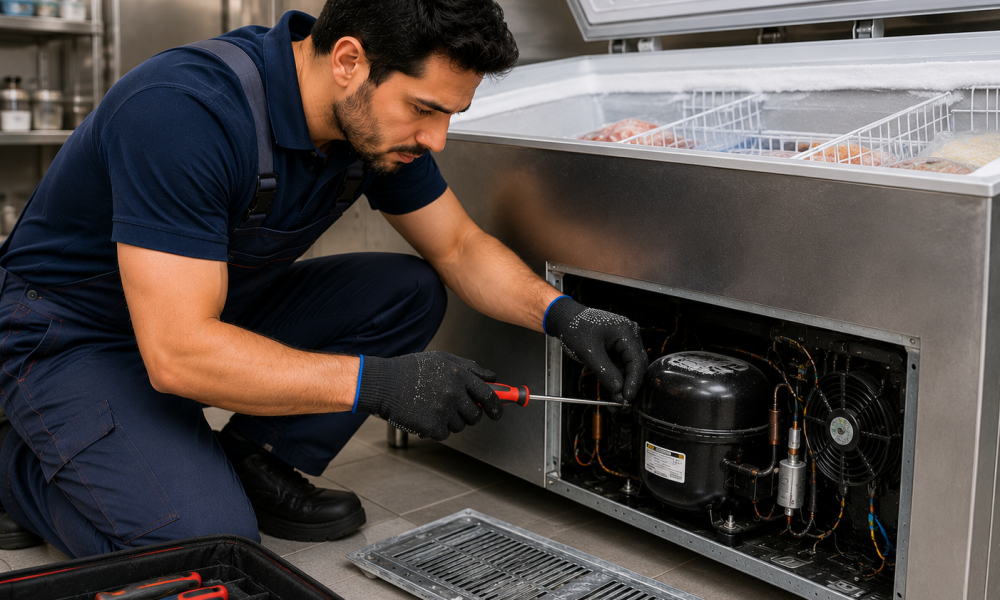
If your freezer isn't freezing properly or your fridge works but the freezer doesn't, we'll identify and fix the issue quickly.
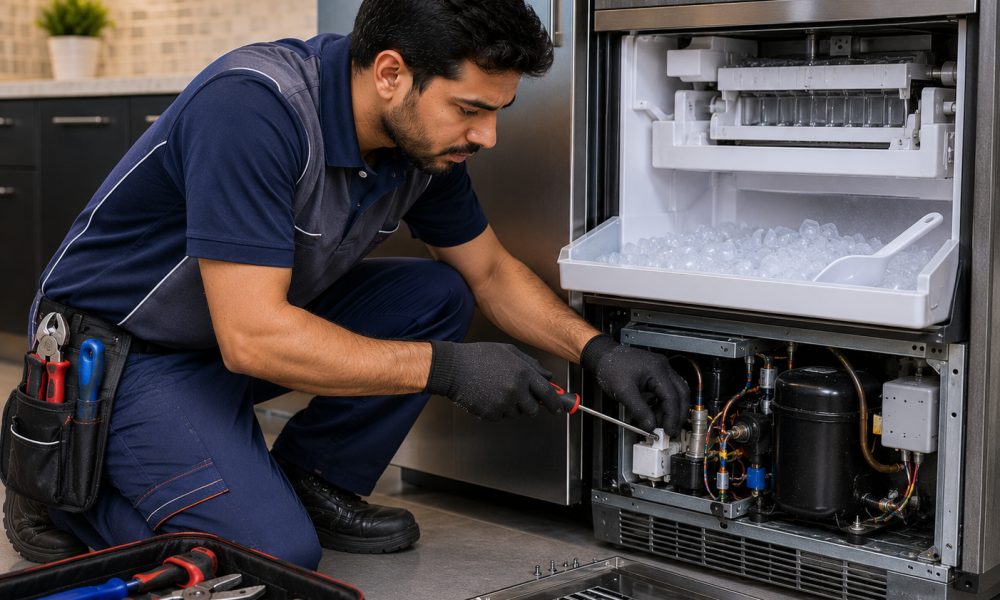
Our technicians repair or replace faulty compressors to restore your refrigerator's cooling performance.
We repair faulty thermostats and temperature control systems to ensure consistent cooling.
Damaged door seals can waste energy and reduce cooling efficiency. We replace worn seals for an airtight fit.
We offer fast, same-day fridge repair services across Sydney to minimise downtime.
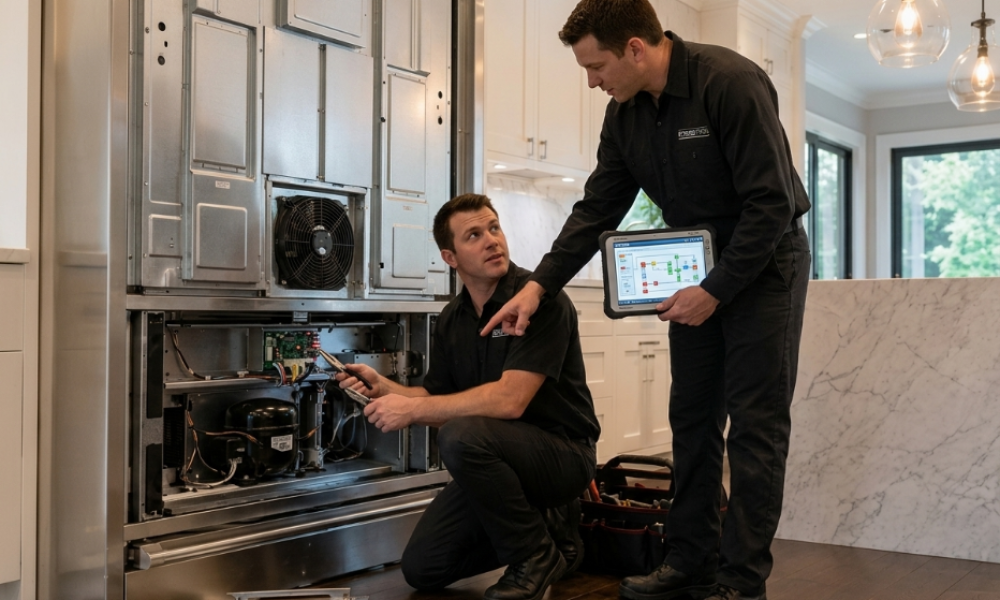
A warm fridge not cooling problem does not come from just one part. Most fridge cooling faults trace back to one of five main areas inside the unit, and each part plays its own role in the cooling process. Our trained technicians know exactly where to look first, and they carry the right tools to confirm the real fault fast. Once the cause is clear, we fix it the right way, so your fridge runs cold again without a repeat visit.
Door Gasket and Seals
The rubber seal around your fridge door keeps cold air inside and warm air out. Over years of use, this rubber can crack, turn brittle, or grow mould along the edges, and cold air then escapes every time the compressor cycles. To test it, close the fridge door on a piece of paper or a dollar note. Pull it out gently. If it slides out with no resistance, the seal is not doing its job anymore.
When the problem is in the door gasket, you may see water drops near the door edge, a warm patch on the frame, or ice close to the seal line. So, just replace the gasket and your fridge not cooling problem will be ok within an hour.
Condenser Coils and Fan
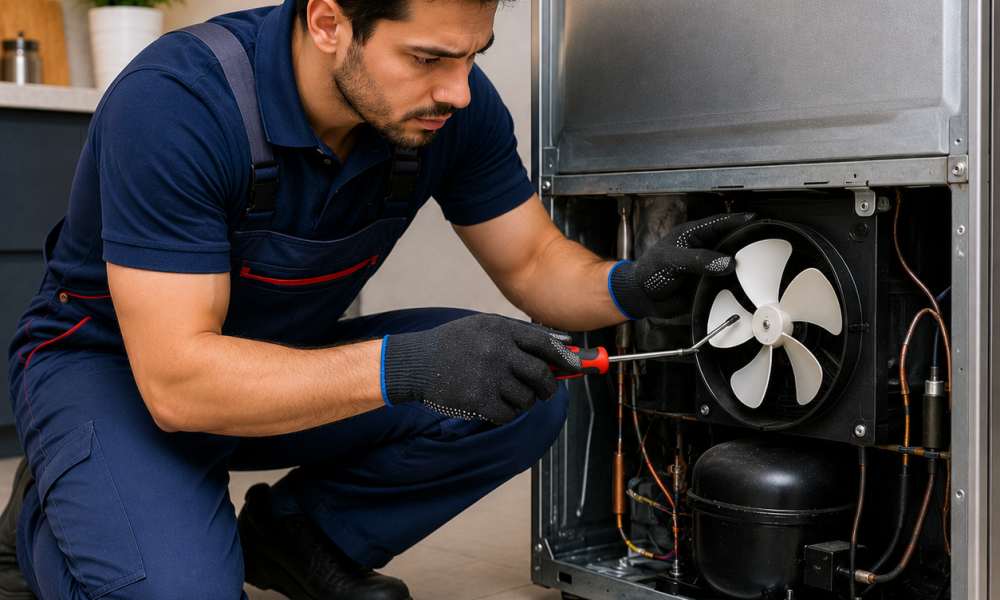
The coils and fan work together to push heat out of your fridge. But over time, dust and pet hair collect on the coils. It traps the heat that should escape, and the condenser fan motor can wear down or jam from debris. When the problem is the condenser coil, you may see a hot patch near the compressor, a rising power bill, or a rattling noise from the base of the unit. Meanwhile, cleaning the coils with a vacuum and a soft brush is simple enough for most people to try. But you need an expert hand to fix the worn fan motor. Our technicians carry the right tools to test, repair, or replace a faulty fan motor on the spot
Defrost System
The defrost system melts frost off the evaporator coil on a regular schedule. A stuck timer, a burnt-out heater, or a faulty sensor can stop this cycle, and ice then builds up and blocks airflow into the fridge. This fault explains one confusing pattern many people search for, where the fridge is not cooling but freezer works. Also, a related but separate issue is a clogged defrost drain tube. Melted frost cannot flow away properly, and it refreezes across the freezer floor or under the crisper drawers instead. Spotting this fault is easy, but the repair needs to be behind panels and requires a licensed technician.
Compressor and Refrigerant
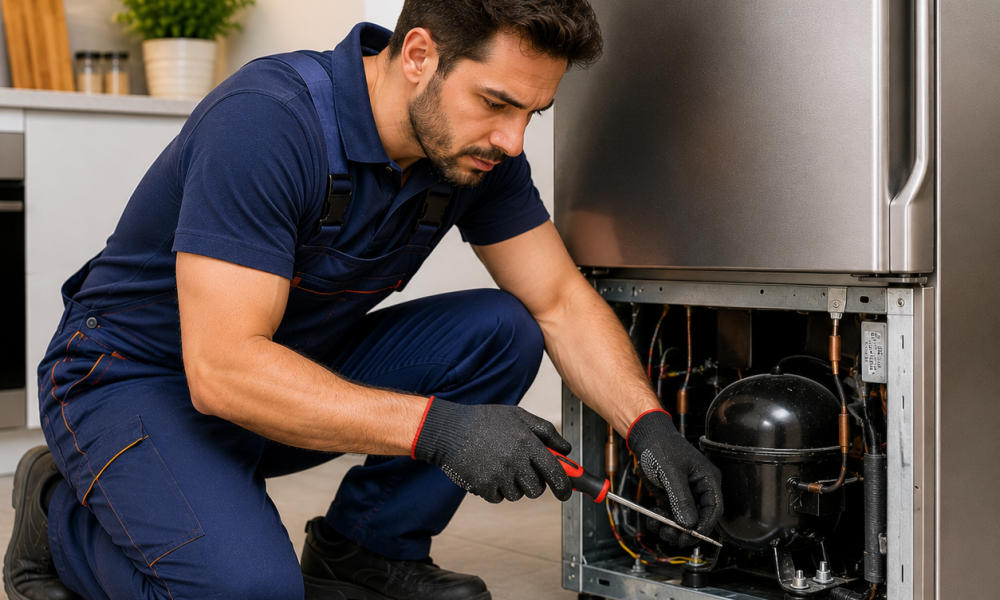
The compressor is the main engine of your fridge. It pressurises refrigerant gas and pushes it through the coils in a closed loop, and this process drives all the cooling your fridge produces. Over the years, a compressor can burn out from constant strain. A refrigerant line can also develop a small leak, or a faulty PTC start relay (Positive Temperature Coefficient, the part that helps the compressor turn on) can stop the compressor from starting at all. If you hear a hum followed by a click every few minutes, this pattern usually points to a failed relay. The fix for this issue is not a DIY task. It needs a proper ARC Tick licence in Australia, and opening the sealed system yourself is both unsafe and against the law under the Ozone Protection Act.
Thermostat and NTC Thermistor Control
The thermostat and NTC thermistor read the internal temperature and tell the compressor and fan when to switch on or off. A drifting sensor, a faulty control board, or a worn dial can leave the fridge running but not cooling or barely running at all. A fridge with this fault may turn on nonstop, or barely turn on at all. The display may show a number that does not match how cold the food actually feels, and cooling can feel inconsistent from one day to the next. To check this, place an independent fridge thermometer inside for 24 hours and compare it against the fridge’s own display reading. However, an old analog dial is easy to replace, but a digital board fault should go to a professional.
A real fix does not start with a guess. It starts with proper testing, and this section explains the methods our technicians use on-site to confirm a fault before any part gets replaced. Once you know what these tests involve, you will understand why a proper diagnosis needs calibrated tools, not guesswork.
A technician checks the defrost heater and the bi-metal thermostat with a multimeter set to the Ohms function. A healthy heater usually reads between 20 and 120 Ω, while a reading of OL (Open Loop) points to a broken element. The bi-metal thermostat should show near 0 Ω while cold, and it should open to OL once it hits its trip temperature. A part stuck fully open or closed often causes a quiet defrost failure that goes unnoticed for weeks.
Modern fridges use an NTC thermistor, or Negative Temperature Coefficient sensor, instead of an old mechanical dial. A healthy thermistor reads close to 10kΩ at 25°C, and this number rises as the temperature drops toward 0°C. A thermistor that gives a fixed reading regardless of temperature, or one that shows OL, has failed. It then feeds the control board wrong information, and this is why a fridge can run nonstop or cycle oddly, even while the compressor works fine.
Most fridges come with a built-in diagnostic mode from the manufacturer, activated through a specific button-hold sequence on the control panel. This forces an immediate defrost cycle, and a technician uses it to quickly confirm whether the heater, the bi-metal, and the defrost timer work together as one system. The exact sequence changes by brand and model, and a wrong combination can trigger an unrelated service mode by mistake.
These resistance ranges help confirm whether a part has failed, but a replacement job is a different task altogether. Defrost heaters, thermistors, and control board components sit close to live connections, and some models use factory-sealed wire harnesses that make the job harder than it looks. A confirmed fault is not the same as a safe fix. If you have spotted any of these signs in your fridge, book an inspection with our team today, and let a trained hand handle the part that needs it most.
Have questions about a fridge not cooling? Find answers to common questions about refrigerators not cooling, freezer cooling issues, compressor problems, repair costs, warning signs, and our professional fridge repair process. Learn how our experienced technicians diagnose and repair fridge cooling problems quickly to restore reliable performance for homes and businesses across Sydney.
This usually points to a problem in the defrost system or a blocked vent between the two compartments. Ice can build up on the evaporator coil and stop cold air from reaching the fridge, even while the freezer stays perfectly cold.
Most fridges take between 4 and 24 hours to reach their full set temperature. The fridge section usually cools faster than the freezer, and it is normal for the unit to work hard during this window.
Yes, in severe cases. When coils get too dusty, heat cannot escape properly, and the compressor can overheat. To protect itself, the compressor's safety switch shuts it down, and cooling stops altogether.
A little warmth near the condenser area is normal. If the surface feels too hot to touch for more than a few seconds, this points to a coil or fan problem worth checking.
Many faults, such as a worn gasket, dusty coils, or an early fan issue, never trigger an error code at all. Codes usually cover electronic sensor faults only, not every mechanical problem inside the fridge.
After a power cut or a house move, a fridge can settle and cool down properly within 24 hours on its own. A genuine part fault will not fix itself this way, and it usually gets worse over time.
The cost depends on the part at fault. A gasket replacement costs far less than a fan motor repair, and a compressor or refrigerant job costs the most. For an exact price, a technician needs to inspect the fridge and confirm the fault first.
A fridge not cooling issue will not fix itself, and every day you wait adds more strain on the parts inside. The good news is that you do not have to guess anymore. You now know the exact signs to watch for and the real reason behind each one.
In fact, our licensed technicians carry the right tools for every test mentioned above, from multimeter checks to full compressor diagnosis. We offer same-day inspection across Sydney, with clear pricing before any work begins. Every fridge not cooling repair Sydney comes backed by a proper workmanship warranty, so you can trust the fix the first time.
Do not let a small fault turn into a costly compressor replacement. Book your appointment today, and your fridge not cooling problem will be solved in the right way.
📞 Call us now, or book online in under two minutes.

Lorem ipsum dolor sit amet, consectetur adipiscing elit. Ut elit tellus, luctus nec ullamcorper mattis, pulvinar dapibus leo.
570 Upton Park,Birmingham, UK
hello @gadgetfix.xom
+14 557 677 001
Lorem ipsum dolor sit amet, consectetur adipiscing elit. Ut elit tellus, luctus nec ullamcorper mattis, pulvinar dapibus leo.
570 Upton Park,Birmingham, UK
hello @gadgetfix.xom
+14 557 677 001